
Artificial Intelligence at the 2026 Annual Conference: What Appraisers Need to Know and Why You Should Be There
By Appraisal Institute
Artificial intelligence is no longer theoretical. It is embedded in platforms, integrated into reporting tools, and influencing how clients think about valuation services. Across the profession, artificial intelligence is shaping workflows, affecting regulatory conversations, and even driving demand in entirely new asset classes.
The question facing appraisers today is not whether artificial intelligence will have an impact. It is whether you will understand it well enough to use it effectively, ethically, and strategically.
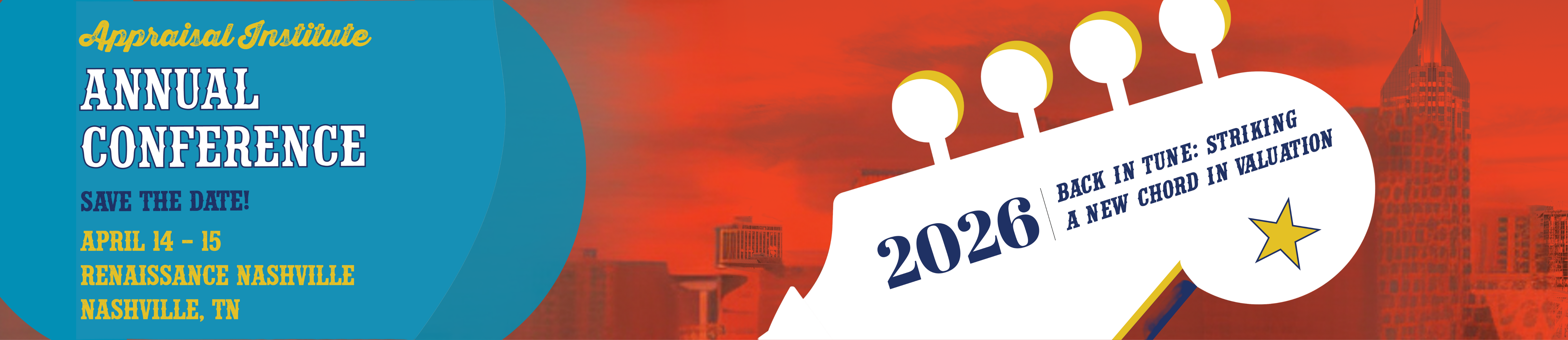
That is why sessions on artificial intelligence are woven throughout our 2026 Annual Conference.
This year’s program treats artificial intelligence as a professional competency. Whether you practice in commercial, residential, review, consulting, or firm leadership, you will find sessions that move beyond headlines and into practical application.
AI in Practice: Real Use Cases with Professional Guardrails
In “AI in Practice: Generative AI Use Cases for Appraisers,” Meghan Czechowski, MAI (Apprise/W&D) and Lucas Rotter (Valcre) focus on how generative AI is already being used in commercial valuation workflows.
You will see examples of how generative AI can support narrative drafting, data synthesis, and workflow efficiency. Just as important, the session addresses USPAP compliance and ethical responsibilities. As generative AI accelerates certain processes, the responsibility for credibility, transparency, and independence remains with the appraiser. Understanding how to integrate generative AI tools without compromising professional standards is essential for maintaining trust in your work product.
The Tools You Already Use Are Evolving
Artificial intelligence is being embedded directly into the platforms and software systems many appraisers already rely on.
“Next-Gen Tools for Today’s Appraiser,” presented by Marius Andreasen, MAI (PwC) and Jeff Hicks (Realwired/YouConnect), explores how artificial intelligence–driven enhancements are improving workflow management, consistency, and operational efficiency. You will gain insight into how automation can reduce administrative friction and allow more time for analytical judgment.
Efficiency gains are only part of the equation. The larger opportunity lies in understanding how technology complements professional judgment rather than replacing it.
Beyond workflow systems, artificial intelligence is also reshaping automated valuation models themselves.
In “AVMs and GenAI: How Powerful Technologies Work Together,” Dr. Michael Seiler (College of William & Mary; Yale University) examines how generative AI is influencing the design, interpretation, and integration of AVMs within residential valuation workflows. As these technologies evolve, understanding how models are built, where their limitations lie, and how they intersect with professional judgment becomes increasingly important.
Rather than positioning automation as a substitute for expertise, this session clarifies how residential appraisers can critically evaluate artificial intelligence–driven outputs, incorporate them appropriately, and communicate their role to clients with confidence and transparency.
Emerging Opportunities: Data Centers and the AI Economy
Artificial intelligence is not only influencing valuation tools. It is driving demand for specialized property types.
In “The Role and Appraisal Needs of Data Centers in the Age of GenAI,” David Chudzik, PhD, MAI, CRE (Colliers) examines the unique valuation considerations associated with data centers and AI-driven infrastructure. Topics include power capacity, cooling systems, tenant stability, lease structures, regulatory exposure, and environmental risks.
As generative AI expands, so does the need for hyperscale facilities and advanced infrastructure. Appraisers who understand the complexities of these assets will be well positioned to serve an expanding market segment.
Residential Application in the Field
Artificial intelligence integration is equally relevant for residential practitioners.
In “AI and Tech on the Ground: Adapting to Using New Tech in the Field,” Jennifer O’Neill, SRA (Appraisal Alliance), and Remington Jones (SFREP) provide practical demonstrations of how generative AI tools intersect with the new URAR and field workflows.
Attendees will see how AI can assist with property descriptions, support data organization, and streamline reporting while preserving accuracy and professional accountability. For residential appraisers navigating reporting changes and evolving technology expectations, this session offers clarity and applied insight.
As generative AI becomes more visible in report development, clarity and disclosure expectations are also evolving.
In “GenAI in the Report: Meeting End-User Expectations with Clarity and Compliance,” Mark Verrett, SRA, ASA (Accurity Consolidated) and Lee Trice (Opteon USA) examine how clients, lenders, and other stakeholders are approaching the use of generative artificial intelligence in valuation assignments. The session explores scope considerations, transparency practices, and communication strategies that support credibility while incorporating new tools.
Understanding not only how to use generative AI but how to explain its role in the appraisal process, is critical. Clear disclosure and thoughtful integration help maintain trust while adapting to shifting end-user expectations.
Ethical application extends beyond reporting and into daily workflow decisions.
In “Using GenAI Ethically,” Nicholas Pilz, MAI, SRA, AI-RRS (Edge Realty Advisors) and Austin Perez (National Association of REALTORS®) examine how to apply generative AI responsibly within appraisal practice. The session emphasizes disclosure practices, appropriate scope considerations, and clearly defined professional boundaries when integrating new tools. As innovation accelerates, maintaining independence, objectivity, and compliance with professional standards remains paramount.
Understanding where generative AI adds efficiency—and where professional judgment must remain firmly in control—helps ensure that technology enhances, rather than compromises, the credibility of the appraisal process.
Strengthening the Human Advantage
Technical knowledge alone is not enough. Professional mindset and positioning matter just as much.
The general session “The Human Edge in an AI World” with keynote speaker Verl Workman (Workman Success Systems) explores how credibility, communication skills, analytical reasoning, and ethical judgment continue to define professional value. Technology may accelerate certain processes, but it does not replace discernment, contextual analysis, or client trust.
Workman expands on this in a separate session, “Becoming Irreplaceable in an AI World,” focusing on how professionals can elevate their role as trusted advisors in a technology-driven environment. The appraisers who lead in the years ahead will combine technological fluency with strong professional identity and client relationships.
Workman also brings a tactical dimension to the conversation in “The Easiest Growth You’ll Ever Have: A Proven System Using AI Assistants, Automation, and Personal Touch to Generate More Work.” This breakout session moves from mindset to execution, demonstrating how generative AI assistants and automation tools can help appraisers stay visible to existing clients, strengthen referral networks, and activate underutilized databases.
Rather than replacing personal outreach, technology-supported systems can enable consistent follow-up, improve responsiveness, and create structured growth strategies. For practitioners seeking measurable business development results, this session provides a repeatable framework grounded in both technology and relationship-building.
Professional visibility is also evolving in a technology-driven environment.
In “Expanding Your Influence: Mastering LinkedIn, GenAI, and the New Find an Appraiser,” Richard Bliss (BlissPoint Consulting – and fellow blog contributor!) explores how generative AI can support strategic communication and client outreach. The session demonstrates how appraisers can refine messaging, enhance digital presence, and leverage modern platforms to strengthen professional connections.
By combining thoughtful content strategy with responsible use of generative AI tools, practitioners can remain visible, relevant, and differentiated in an increasingly competitive marketplace.
Learning From the Profession Itself
Artificial intelligence adoption is also advancing through peer collaboration.
In “The Best of GenAI: Success Stories and Tips From AI on AI,” Mark Linné, MAI, SRA, AI-GRS, FRICS (Candescent Capital Ventures) shares insights drawn from the Appraisal Institute’s new generative artificial intelligence course and professional community. Over six months, appraisers from across the country explored practical applications, tested tools, identified limitations, and refined best practices.
This session distills those real-world experiments into actionable guidance, highlighting what is working, where caution is warranted, and how practitioners can responsibly expand their use of generative AI. Learning from peers who are actively experimenting and refining processes accelerates adoption while reinforcing professional standards.
Why This Matters Now
The Appraisal Institute’s broader focus on modernization, education, and technology integration reflects a clear reality: the valuation profession is evolving rapidly.
Clients are increasingly aware of automation. Regulators are examining technology integration. Investors are funding artificial intelligence–driven valuation platforms. Entire sectors are expanding because of generative AI demand.
Maintaining relevance requires understanding both the capabilities and limitations of these tools. The 2026 Annual Conference provides concentrated access to education, demonstrations, peer discussion, and expert insight.
Reading about artificial intelligence offers awareness. Engaging directly with practitioners and technologists offers perspective, nuance, and practical understanding.
Position Yourself at the Forefront
The 2026 Annual Conference offers more than exposure to new tools. It provides a framework for integrating artificial intelligence responsibly and strategically into your practice.
- Understand real-world AI applications.
- Clarify compliance and ethical boundaries.
- Explore emerging property sectors tied to artificial intelligence growth.
- Improve workflow efficiency.
- Strengthen your professional positioning.
- Connect with peers navigating the same transformation.
Technology will continue to advance. Professional credibility, analytical rigor, and ethical standards remain the foundation of valuation practice.
Appraisers who integrate both technological fluency and professional excellence will shape the future of our community.
Join us at the 2026 Annual Conference and ensure you are prepared for what comes next.