
Appraisal Bias Allegations Moving Forward Under Fair Housing Act

In this issue:
- Appraisal Bias Lawsuit: Lender and AMC must defend allegations under Fair Housing Act
- Real Estate Analyst Professional Development course offerings
- Appraiser Liability Trends: Litigation Risks for Commercial and Residential Appraisers
- Fannie Mae Updates Comp Physical Inspection, ROV Policies
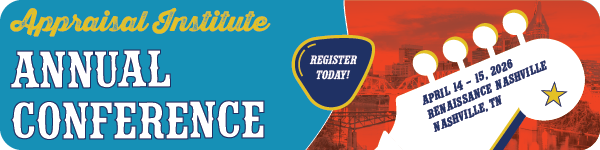
Registration is Now Open for 2026 Annual Conference!
We’re back in tune – and we can’t wait to see you in Nashville!
Join hundreds of valuation professionals April 14-15, 2026, for the Appraisal Institute Annual Conference, packed with energy, innovation and connections you won’t find anywhere else. This year’s conference theme, Back in Tune: Striking a New Chord in Valuation, highlights hands-on learning, interactive demos and practical insights to help you thrive in a changing profession.
Insights
Appraisal Bias Suit Against Mortgage Lender and AMC Moves Forward
A federal judge has ruled that Rocket Mortgage and appraisal management company Solidifi must defend themselves against allegations of appraisal bias under the Fair Housing Act.
The case involves a 2021 appraisal in Denver by appraiser Maksym “Max” Mykhailyna, which valued homeowner Francesca Cheroutes’s duplex at $640,000 — more than $220,000 below its prior year value. Both the Department of Justice and Cheroutes allege that the report relied on faulty comparables and reflected racial bias. Mykhailyna has denied the allegations.
In rejecting motions by Rocket and Solidifi to dismiss the claims, Judge Gordon Gallagher clarified that appraisal independence regulations do not prevent lenders or AMCs from addressing potentially biased or deficient reports. The court noted that Rocket could have requested corrections or ordered a second appraisal rather than canceling Cheroutes’s loan application. Gallagher also held that Solidifi could be found vicariously liable for discriminatory practices, even if the appraiser was classified as an independent contractor.
Importantly, Gallagher highlighted that both federal and Colorado appraisal independence requirements allow AMCs to request additional information, ask for further details to support a valuation, or correct errors, actions consistent with addressing allegations of bias.
The ruling underscores two critical issues for the profession. First, appraisers, lenders, and AMCs remain under close watch as courts, regulators, and the public continue to examine allegations of racial bias in valuation. Second, while appraisal independence protects appraisers from undue influence, it does not insulate lenders or AMCs from accountability when credible bias concerns are raised.
For AI members, this case is an important reminder: appraisal independence is not a shield against scrutiny. Courts and regulators expect appraisers, AMCs, and lenders to uphold both independence and fairness. Maintaining defensible methodologies, ensuring comparables are appropriate, and documenting professional judgment remain the best safeguards against allegations of bias — and against drawing lenders and AMCs into costly litigation.
Coming Soon: Valuation Bias and Fair Housing Laws and Regulations
We’re excited to announce a new seminar: Valuation Bias and Fair Housing Laws and Regulations. This required course provides appraisers with essential training on civil rights protections, valuation bias, and fair housing laws, which is designed to help you stay compliant, strengthen public trust, and best serve your clients.
Join the wait list today to be among the first notified when registration opens.
Your Benefits
Maximize Your Portfolio's Potential!

Heartland provides tailored payment and payroll solutions designed to help your business reach its full potential. With the perfect blend of advanced tools and personalized support, we simplify the process, allowing you to concentrate on growing your business while we manage the intricate details.
Explore flexible payment and payroll options crafted to fit your needs.
- Payments+ is a flexible payment solution that empowers you to run your business from just about anywhere.
- Payroll+ is a secure, cloud-based solution that helps you handle payroll, tax management, hiring, onboarding, time and attendance, HR, and so much more — all under one roof.
Connect with us to unlock exclusive member pricing and offers!
Trending Topics Thursdays:
Sign up for our next free webinar

Appraiser Liability Trends: Litigation Risks for Commercial and Residential Appraisers
The Appraisal Institute is proud to present this webinar in partnership with Liability Insurance Administrators (LIA) - the only Errors & Omissions program endorsed by the Appraisal Institute since 1991, and the largest program in the U.S. dedicated to appraisal professionals. In addition to E&O, AI members now also have access to LIA’s endorsed General Liability and Cyber Liability Insurance products, offering comprehensive protection for today’s evolving risks.
Presenter: Steven Bauer, Attorney, Gaglione, Dolan & Kaplan
During this session, experienced outside counsel will spotlight the latest litigation trends and liability risks impacting both residential and commercial appraisers. Attendees will walk away with practical strategies for risk management, a stronger understanding of how claims arise, and best practices for mitigating exposure in a shifting legal landscape.
Key Litigation Issues to Be Covered
- Overvaluation and Undervaluation Claims
Why appraisers are frequently drawn into disputes when market performance, foreclosures, or resales differ from their opinions of value. - Bias and Fair Housing Allegations
The rising wave of appraisal bias claims, federal scrutiny, and how appraisers can protect themselves through sound practice and documentation. - Engagement Letter and Scope-of-Work Disputes
How unclear assignment terms create litigation risk — and steps to ensure clarity and defensibility. - Third-Party Liability
Expanding exposure from borrowers, buyers, and others outside the client relationship, and strategies to limit liability. - Regulatory and Disciplinary Proceedings
The interplay between board complaints, federal investigations, and civil claims. - Risk Management Best Practices
Practical steps appraisers can take to reduce exposure — including maintaining independence, careful recordkeeping, and leveraging liability insurance.
Determining the Larger Parcel (Sponsored by the International Right of Way Association)
Wednesday, October 29, 2025, 1-3 PM ET
This IRWA webinar - recommended for Appraisal Institute members - drills down to the core of larger parcel determination in real estate appraisal. Learn how Federal Agency Review Appraisers approach the larger parcel and see how the definition tests are applied through real-world case studies ranging from salt harvesting operations to large-scale conservation easements. Consider how jurisdiction and supplemental standards, including the Uniform Appraisal Standards for Federal Land Acquisitions (UASFLA, the “Yellow Book”), shape conclusions.
Four focused presentations will cover the essential components:
- Highest and Best Use
- Unity of Title
- Unity of Location/Contiguity
- Unity of Use
Panelists:
- Steven Kunkel, MAI - Chief Appraiser, Western Area Power Administration
- Barbara Kaczmarek, MAI - Lead Appraiser, Federal Aviation Administration
- Mark Worthen - Chief Appraiser, Naval Facilities Engineering Systems Command (NAVFAC)
- Eric Roman, MAI, SR/WA, AI-GRS, R/W-AC - Chief Appraiser, U.S. Army Corps of Engineers, South Pacific Division
- Tim Hansen, RPRA, MNAA - Former Chief Appraiser & Director, Department of the Interior Appraisal and Valuation Services Office (AVSO)
Advocacy Updates
Fannie Mae Releases Q3 2025 Appraiser Update
Fannie Mae has released its Q3 2025 “Appraiser Update,” introducing several significant changes that appraisers should be aware of. One of the most notable updates comes with the rollout of UAD 3.6, which replaces the old 1004/1004D dual-use form with two distinct reports.
The new Restricted Appraisal Update Report is required when the original appraisal is more than four months but less than 12 months old as of the note date. Much like the legacy 1004D, it must confirm whether the value has declined; if so, a new appraisal is needed. The original appraiser is preferred, though not required, and the property’s exterior must still be inspected with a front photo included. The new Completion Report, meanwhile, is designed to verify that improvements or repairs from the original appraisal are finished. It calls for an itemized list of those repairs, photos and status updates, and documentation of any new repairs observed. For properties that were “subject to completion,” the appraiser must also comment on whether the construction is consistent with original plans, noting if it is superior, similar, or inferior. Virtual inspections can be used in some cases with verifiable exhibits, and as with the Update Report, the original appraiser is preferred if feasible. Both reports must be submitted to Fannie Mae through the UCDP by the lender or authorized agent.
Another major change is the removal of the long-standing requirement to physically inspect comparable sales “from at least the street.” While appraisers must still provide front photos, the mandate to conduct a drive-by has been eliminated. Appraisers remain responsible for researching, verifying, and analyzing reliable data to support their comparable selection and adjustments. To help appraisers with compliance under the new UAD framework, Fannie Mae has also rolled out a Compliance API. This tool is designed to check data completeness, formatting, validity, and reasonableness before reports are submitted, though it does not provide Collateral Underwriter® scoring or value-support messages.
In addition to these UAD changes, Fannie Mae has updated its reconsideration of value policies. Lenders are no longer required to provide the initial ROV disclosure at the time of loan application. Instead, the disclosure must now only be delivered to borrowers when they receive the appraisal report. Documentation of ROV outcomes is still required in the loan file, but the process has been simplified.
For appraisers, these updates bring both new efficiencies and new responsibilities. The elimination of the comp drive-by requirement may save time in the field, but it also places greater emphasis on careful data research and photo documentation. The split into two distinct reports under UAD 3.6 will require a learning curve, as will the adoption of the new compliance tools. Ensuring that software is updated to handle these new requirements will be critical, as will maintaining clear and complete documentation of repairs, photos, and comparable analysis.
Now is the perfect time for appraisers to prepare for UAD 3.6 with the Appraisal Institute’s URAR Companion Courses, designed to help you stay ahead of these changes with confidence.
Real Estate Horizons
Stay updated and check out links to the latest major real estate industry stories!
More Opportunities to Learn
Search the latest educational offerings! Find National and Chapter-sponsored classroom, synchronous, and online opportunities.
Your Community
AI Award Nominations – Deadline Extended to December 1, 2025
Know an exceptional leader? Beginning in 2026, our national awards will once again be presented at the Appraisal Institute Annual Conference. These honors are among the highest recognitions in our organization and presenting them during our largest gathering reflects their true significance. To align with this return to a time-honored approach, the nomination deadline for our annual awards has been extended to December 1, 2025. This extension ensures ample time for thoughtful nominations and allows us to celebrate our honorees at the Annual Conference in April 2026.
Please nominate an AI colleague today for one of our highest honors.
Until Next week
Team Appraisal Institute