
Bridging the Appraiser-Underwriter Divide on LTV Risk

In this issue:
- LTV Ratios: Where Bayesian thinking fits in mortgage underwriting
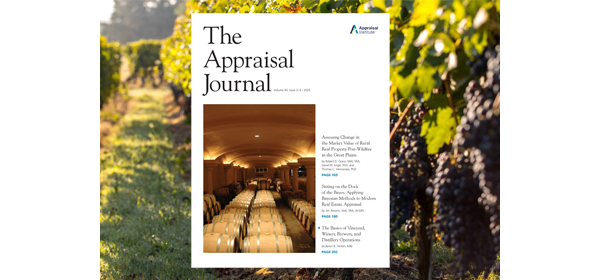
- The Appraisal Journal: New issue out now!
- HUD Proposal: How rescinding the fair housing “Disparate Impact” Rule affects appraisers
- AI Blog: See the first two entries from Annual Conference presenters
Insights
Rethinking LTV Pressure: How Bayesian Thinking Can Clarify the Appraiser–Underwriter Divide
Loan-to-value ratios are deeply embedded in mortgage underwriting. From maximum loan amounts to pricing adjustments and risk modeling, the system is traditionally built around a single number: market value. That structure assumes precision — but in practice, it often places disproportionate pressure on appraisers to make transactions work. The Appraisal Institute and its community members have historically brought the suggestion of a range, rather than a single number, estimate to regulators to promote flexibility.
A recent article in The Appraisal Journal, “Sitting on the Dock of the Bayes: Applying Bayesian Methods to Modern Real Estate Appraisal,” by Jim Amorin, MAI, SRA, AI-GRS, supports that recommendation and offers a framework that could help reduce that pressure by addressing a fundamental mismatch between how valuation works and how underwriting consumes it.
The Problem with Single-Point Estimates
Real estate valuation is inherently uncertain, yet mortgage underwriting frameworks typically require a single-point value conclusion. That number becomes the anchor for LTV calculations, automated risk metrics, and approval thresholds.
For appraisers, this creates a familiar challenge. When a deal hinges on whether the value clears a specific line, pressure — sometimes subtle, sometimes overt — can fall on the appraiser to “get there.” In effect, valuation becomes the perceived bottleneck through which underwriting risk decisions are pushed.
But deciding whether a loan should proceed near a threshold is not an appraisal function. It is an underwriting decision.
Where Bayesian Thinking Fits
Amorin’s article explores how Bayesian methods allow appraisers to move beyond a single-point estimate and instead express value as a most probable value supported by a defined range, based on the quality and consistency of market evidence.
This does not mean appraisers approve higher-risk loans or loosen standards — quite the opposite. Bayesian thinking formalizes uncertainty that already exists but is rarely quantified. It allows appraisers to say, in a defensible way:
- Here is the most likely value, based on current data.
- Here is the reasonable range within which market value likely falls.
- Here is how confident we are, given the available evidence.
That information is already implicit in competent appraisal work. Bayesian methods simply make it explicit.
Returning Risk Decisions to Underwriting
A value range does not change underwriting guidelines. LTV requirements would still be applied as written. But a range-based presentation, designed in collaboration with standards setters and stakeholders, gives underwriters clearer insight into where the risk actually lies, rather than forcing that judgment into the appraisal number itself.
In other words:
- The appraiser provides credible valuation information.
- The lender decides whether lending near the upper end of that range is acceptable.
- Accountability for risk shifts back to underwriting, where it belongs.
This approach could reduce incentives for value inflation while improving transparency across the lending process.
Why This Matters Now
As mortgage markets remain competitive and regulatory scrutiny persists, clarity around roles matters. Appraisers should not be asked to solve underwriting constraints with valuation assumptions.
Bayesian thinking offers a way to preserve appraisal independence, communicate uncertainty honestly, and support better lending decisions without changing who ultimately bears responsibility for risk.
Your Benefits

As a member of the Appraisal Institute, you receive discounted access to AirDNA’s Rentalizer, a powerful tool designed to help you accurately assess the short-term rental income potential of residential properties.
By entering an address and key property details, Rentalizer delivers real-time projections for average daily rates, occupancy rates, and annual revenue, using data from comparable Airbnb and Vrbo listings. This supports more robust income capitalization approach valuations and allows you to evaluate the viability of short-term versus traditional rental models.
To see the tool in action, check out this demo video or explore the full capabilities in AirDNA’s Rentalizer Guide.
Enhance your valuation practice with this exclusive AI member benefit today by using the code: AI20.
AI members will receive a 20% discount on Pro subscriptions.
Learn more about pricing (you will need to set up a free account with AirDNA to view pricing details).
Trending Topics Thursdays:
Sign up for our next free webinar

Online Reputation Management for Appraisers
Protect credibility, reduce friction, and communicate like a digital-first pro
In a high-scrutiny profession, reputation is an asset—and online communication can either strengthen it or quietly erode it. In this session, Richard Bliss shares a practical roadmap for digital reputation management, including what to post, what to avoid, and how to communicate confidently online. Joined by AI’s Director of Education, the discussion will focus on professional credibility, ethical boundaries, and how to present expertise clearly in public forums.
Bullet outcomes:
- Do’s and don’ts of professional posting (especially when topics are heated)
- How to respond to comments or criticism without escalating
- Building trust signals: consistency, clarity, and proof of competence
- A “safe and smart” content plan for regulated professionals
Learn how to communicate online in a way that protects credibility, builds trust, and strengthens your professional reputation.
Thu, Feb 19, 2026 11:00 AM - 12:00 PM CST
Advocacy Updates
HUD Proposes Rescinding Fair Housing “Disparate Impact” Rule
HUD has issued a proposed rule that would rescind key elements of its Fair Housing Act “discriminatory effects” (disparate impact) framework, marking a significant shift in how HUD evaluates practices that may produce unequal outcomes among protected classes. The proposal argues HUD’s prior rules formalized legal tests not explicit in the statute and created a presumption of unlawful discrimination based on outcome differences. Public comments are due February 13, 2026, and the Appraisal Institute intends to submit comments on the proposal.
Scott DiBiasio, Director of Federal Affairs, said: “While we fully support the Fair Housing Act’s purpose and protections, the disparate impact framework has too often been applied in ways that treat appraisers as convenient enforcement targets—punishing valuation outcomes without clear evidence of discriminatory intent or appraisal standard violations.”
(NEW) Blogs
At this year’s Annual Conference, advocacy will take center stage.
From regulatory changes affecting residential appraisers to legislative and licensing issues impacting commercial practice, two key sessions will explore the advocacy issues shaping the future of the profession and how the Appraisal Institute is working on your behalf at the local, state, and federal levels.
Interested in learning more? Get a preview of what you will learn and meet the experts leading these conversations in our latest blog.
Real Estate Horizons
Stay updated and check out links to the latest major real estate industry stories!
More Opportunities to Learn
Search the latest educational offerings! Find National and Chapter-sponsored classroom, synchronous, and online opportunities.
Our Community
AI PAREA Update: 67 Graduates, 48 Credentials, 100% Pass Rate
AI PAREA continues to build momentum, and we’re proud to share a major milestone: 67 program graduates to date. Those graduates have earned 48 state appraisal credentials, and the program continues to maintain a 100% pass rate by those who have taken and reported exam results.
We also kicked off our first “AI PAREA Orientation” for the new TAF scholarship cohort, covering expectations, tips for success, mentor introductions, and insights from a special guest speaker, an AI PAREA graduate, on his path into the profession. Enrollment for the Q4 TAF cohort is underway, with 21 of 63 participants enrolled so far and additional enrollments continuing over the next several weeks.
Until Next week
Team Appraisal Institute