
Housing Policy Takes Center Stage: New Limits on Institutional Homebuyers

In this issue:
- Housing Policy Executive Order: What it means for residential real estate
- Free Webinar: Online reputation management for appraisers
- HUD Oversight Updates: Appraisal complaint backlog
Insights
Housing Policy Moves to the Center of the 2026 Debate
Housing policy has moved squarely into the national spotlight as President Donald Trump signs an executive order aimed at restricting large institutional investors from purchasing single-family homes. While the order does not ban institutional buying outright, it directs federal agencies to withdraw federally backed financing, insurance, guarantees, and securitization channels that facilitate such acquisitions. Agencies have 60 days to identify these restrictions, and the Treasury Department must define “large institutional investor” within 30 days, a decision that will determine how broadly the policy applies.
The administration argues that families cannot meaningfully compete with large firms for scarce starter home inventory. Treasury Secretary Scott Bessent has emphasized that “mom and pop” landlords who own just a handful of properties are not the target. Critics counter that the policy risks distracting from deeper affordability issues facing households struggling to buy even one home.
Markets reacted quickly: shares of major homebuilders and institutional rental operators, including Blackstone, Invitation Homes, KB Home, and PulteGroup, declined following the announcement. Industry groups point out that large professional operators own less than 1% of single-family homes nationally, raising questions about whether the order will significantly affect affordability. The Department of Justice and the Federal Trade Commission will also review large or serial acquisitions for potential anticompetitive concerns.
Additionally, the order includes a carveout for purpose-built build-to-rent communities, preserving a key development pathway even as bulk purchases of for-sale homes face new scrutiny.
Additional Affordability Proposals Under Review
- 50-year mortgages, criticized for slowing equity accumulation
- Portable mortgages, allowing borrowers to transfer an existing mortgage to a new home
- Penalty-free retirement withdrawals to assist with down payments
Reinforcing Confidence and Competency
As regulators revisit risk frameworks and tighten scrutiny on investor behavior, appraisers have an essential role as market integrity partners. This is an important moment to highlight the depth of professional expertise within the field, particularly through advanced designations like the SRA, which demonstrate rigorous training, ethical commitment, and the analytical judgment required for today’s evolving residential market.
Your Benefits

The AI Education and Relief Foundation (AIERF) is a charitable entity that supports the appraisal community in meaningful ways. From providing invaluable resources like the Y.T. and Louise Lee Lum Library to grants and scholarships, AIERF's mission is to make a real difference. AIERF also steps up when disaster strikes, providing financial assistance to AI members and others in the real estate profession who are impacted by catastrophic events or emergencies.
Trending Topics Thursdays:
Sign up for our next free webinar

Online Reputation Management for Appraisers
Protect credibility, reduce friction, and communicate like a digital-first pro
Thu, Feb 19, 2026 11:00 AM - 12:00 PM CST
In a high-scrutiny profession, reputation is an asset—and online communication can either strengthen it or quietly erode it. In this session, Richard Bliss shares a practical roadmap for digital reputation management, including what to post, what to avoid, and how to communicate confidently online. Joined by AI’s Director of Education, the discussion will focus on professional credibility, ethical boundaries, and how to present expertise clearly in public forums.
Bullet outcomes:
- Do’s and don’ts of professional posting (especially when topics are heated)
- How to respond to comments or criticism without escalating
- Building trust signals: consistency, clarity, and proof of competence
- A “safe and smart” content plan for regulated professionals
Learn how to communicate online in a way that protects credibility, builds trust, and strengthens your professional reputation.
Advocacy Updates
Loudermilk Presses HUD on Appraisal Complaint Backlog and Due Process
During a recent HUD oversight hearing, Rep. Barry Loudermilk (R‑GA) pressed the agency on its handling of appraisal‑related fair housing complaints, building on the Appraisal Institute’s ongoing engagement with House Financial Services Committee staff. Loudermilk expressed concern that HUD has too often treated appraisers as “convenient enforcement targets,” with valuation outcomes penalized even when there is no evidence of discriminatory intent or violations of appraisal standards. He emphasized that this approach has subjected appraisers to significant professional and reputational harm, often leaving them entangled in lengthy investigations without clear justification.
Loudermilk asked HUD Secretary Scott Turner to outline what procedures and timelines exist to close complaints that lack merit and how HUD plans to reduce the large backlog of unresolved cases so appraisers are not kept in prolonged uncertainty.
Secretary Turner responded that HUD is working to streamline its Fair Housing and Equal Opportunity (FHEO) processes, including those involving appraisal‑related complaints. He underscored a renewed focus on accountability and prioritization of “real discrimination cases, not phantom cases,” noting that the agency inherited a backlog affecting roughly 70% of pending cases from the previous administration—many of which exceeded HUD’s 100‑day investigation requirement. Turner stated that his team is actively working to reduce the backlog and improve both the speed and clarity of future case resolutions.
Expanded Eligibility and New “Waiver + Property Data” Programs
Policy adjustments and new collateral tools continue to shape waiver usage. In Q1 2025, Fannie Mae expanded waiver eligibility to purchase loans with 80–90% combined loan-to-value (CLTV). By November, about 9% of those loans used a waiver, up from 2% in February 2025.
Beyond traditional waivers, both GSEs are relying more on alternatives that incorporate onsite property data collection. Freddie Mac’s ACE+PDR program (introduced in July 2022) represented 2.2% of purchase loans, 1.8% of cash-out refinances, and 1.6% of no cash-out refinances in November 2025. Fannie Mae’s similar option—Value Acceptance + Property Data (VA+PD)—accounted for 2.6% of purchase loans, 5.7% of cash-out refinances, and 3.7% of no cash-out refinances in November.
Why It Matters
The latest figures reinforce that appraisal waivers remain a significant share of GSE activity, and that the enterprises are continuing to refine “data-driven” collateral evaluation pathways, including programs that rely on property data collection in lieu of a traditional appraisal assignment.
AI PAC Chapter Challenge Is Heating Up!
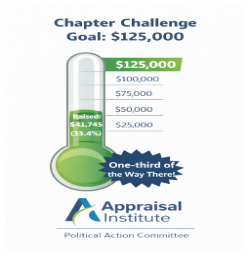
The AI PAC Chapter Challenge is officially underway, and the early momentum is in! Thanks to generous support from chapters across the country, we’ve already raised $13,250 toward our $125,000 goal: just over 10% in the door.
This is exactly how strong campaigns start: early leaders step up, others see the progress, and the momentum builds. Every contribution moves us closer to ensuring appraisers have a stronger voice on Capitol Hill.
We’re just getting started, and there’s plenty of room at the top of the thermometer. Let’s keep it climbing!
Real Estate Horizons
Stay updated and check out links to the latest major real estate industry stories!
More Opportunities to Learn
Search the latest educational offerings! Find National and Chapter-sponsored classroom, synchronous, and online opportunities.
Until Next week
Team Appraisal Institute