President's Message
As we move further into the year, I want to share a few updates and initiatives that reflect both the breadth of our work and our continued focus on supporting appraisers in meaningful, practical ways.
National Governance
Earlier this month, the Board of Directors and Regional Third Directors heard presentations on the characteristics of high-functioning boards, governance best practices, fiduciary responsibilities and other training in a day-long session that preceded the actual first quarter board meetings. An award-winning association management company with over 50 years of expertise with professional associations and non-profit organizations talked to us about the strategic planning function of boards, a board’s role in the culture of an organization, optimal board size and composition, governance models, board-directed committees, and a whole host of related topics. This discussion grew out of the work of a Board-appointed task force established in 2025 to review the Appraisal Institute’s policies to help ensure a more welcoming environment, and whose scope was later expanded by the board to include recommendations on the national governance structure. Specifically, this included examining the size and composition of the board, director terms and qualifications, and how directors are elected to the board.
You should have already seen a survey sent out by the Election Process Project Team, which was appointed in 2025 by President Konikoff, soliciting opinions and ideas about how our national officers are elected, the role of the National Nominating Committee, etc. As their work continues, their recommendations will be a key part of the governance overhaul effort as well.
This is not a reprise of the Governance Structure Project Team’s work from nearly a decade ago, which recommended sweeping changes across national, regional, and chapter governance. Instead, the current initiative is focused solely on national governance, including the Board of Directors (which includes the executive officers), national committees, and related bylaws, regulations, and policies. As the year continues, we are committed to carrying this effort forward to produce a reinvented, strategic and efficient board our membership deserves and expects.
Staying Connected to Board Priorities
Related to the discussion above, transparency and communication remain essential as we continue the work of strengthening the organization. I encourage members to take a few minutes to review the Q1 Board of Directors Meeting recap from the February 10 session. These slides and summary materials highlight the Board’s most important discussions and actions and provide helpful insight into the priorities guiding our work in the year ahead. Staying informed about these conversations is one more way members can remain engaged with the direction of the Appraisal Institute.
Expanding Capacity in Conservation Valuation
One area where we continue to see the value of collaboration is our ongoing partnership with the Land Trust Alliance and Appraisal Institute chapters. Over several years, these coordinated efforts have focused on expanding the pool of appraisers qualified to complete conservation valuation assignments by supporting targeted education and training opportunities, including stipends for appraisers interested in conservation easement work. The next offering of our course will take place March 24–27 in Richmond, Virginia, through the Virginia Commonwealth Chapter, and it represents another step forward in strengthening this important area of practice while supporting appraisers who wish to broaden their expertise.
Helping Appraisers Be Intentional About Growth
Uncovering Your Business Potential is a suite of interactive, chapter hosted workshops designed to help appraisers move beyond day-to-day demands and be more intentional about how they grow their businesses. Through hands-on, practical sessions, appraisers gain clear strategies to strengthen client relationships, communicate their value with confidence, identify new market opportunities, and build focused, sustainable practices.
The premiere offering in this series is slated for March, with chapters able to add these programs for their members throughout the year.
A Timely New Educational Offering on the URAR
Looking ahead, we are pleased to announce a new seminar, Analyzing Defects, Damages, and Deficiencies in the New URAR, launching April 23, 2026. Offered through the South Carolina Chapter in both synchronous and classroom formats, this program is designed to help appraisers confidently identify, analyze, and report property conditions using the redesigned URAR. With case studies applicable to both residential and commercial practice, this seminar responds directly to questions many appraisers are navigating as reporting requirements continue to evolve.
Advocating for Fair, Evidence-Based Enforcement
Finally, I want to highlight our recent advocacy work on behalf of the profession. The Appraisal Institute recently submitted a formal comment letter to HUD in response to the Department’s proposed rescission of key elements of its Fair Housing Act disparate impact framework. In that letter, AI reaffirmed strong support for fair housing goals while emphasizing that appraisals are independent, data driven professional judgments. The Institute expressed support for HUD’s recognition that outcome disparities alone are not proof of unlawful discrimination and for efforts to restore a more balanced, evidence-based enforcement approach, one that focuses on intentional discrimination and biased practices while protecting appraisal independence and due process. I encourage members to review the letter to better understand how we are advocating for the profession.

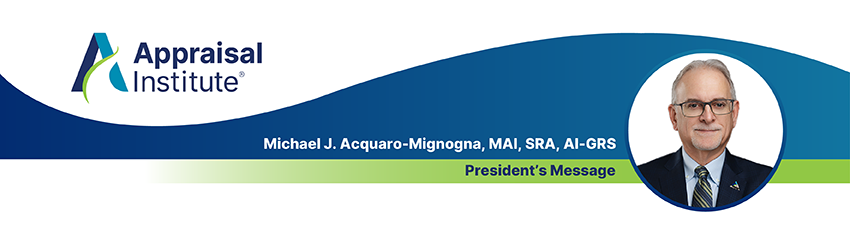
Michael J. Acquaro-Mignogna, MAI, SRA, AI-GRS
President
Appraisal Institute